The New Binders of Community
By Arash Shiva
A neighborhood association can have a mailing list, a group chat, and a shared calendar without becoming a community. People may see the same messages every day and still have no reason to trust one another when something important is at stake.
The difference becomes clear when a real need arrives. Who will watch a neighbor's child for an hour? Who can recommend a reliable plumber? Who gets to decide how a shared budget is spent? These questions need more than common interest. They need a way to know who belongs, a set of expectations about how people treat one another, and some practical exchange that gives the relationship a reason to continue.
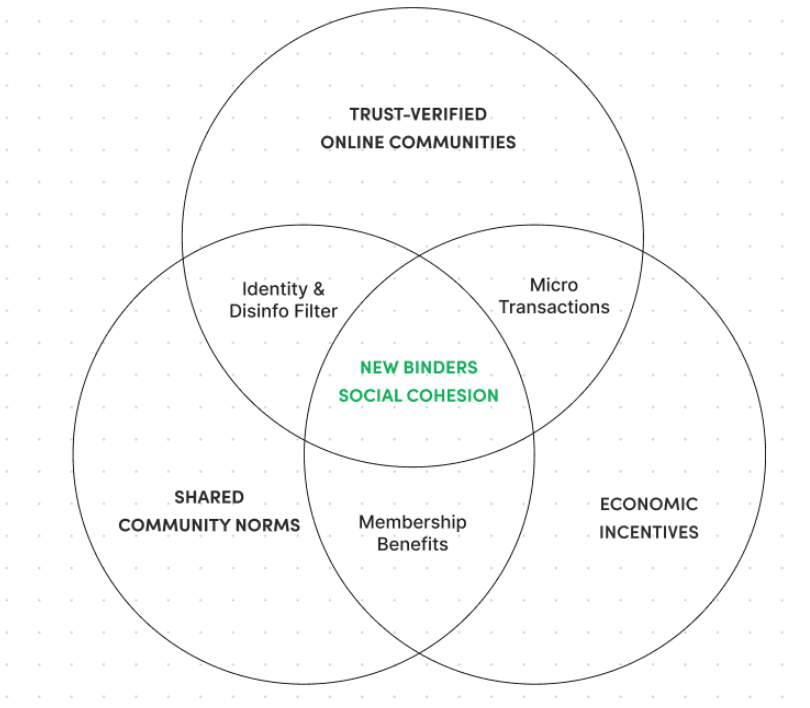
I think of these as the new binders: trust-verified online communities, shared community norms, and economic incentives that reward participation. Together, they might give people a way to belong and cooperate when older institutions no longer carry as much authority.
The Institutions We Used to Rely On
Large institutions once supplied many of the structures that made cooperation possible. A church, union, newspaper, school, or local employer could give people a shared place, a common vocabulary, and repeated contact with the same people. Those institutions were not always fair or welcoming. They could demand conformity, exclude outsiders, and protect their own power. But they did provide a social setting in which trust could accumulate over time.
That inheritance is weaker now. In a 2022 Gallup survey, average confidence across fourteen U.S. institutions fell to 27%, a new low in the poll's trend. Small business was trusted by 68% of respondents, while Congress was trusted by only 7%. These aggregate figures show low overall confidence across the institutions surveyed, but they do not tell us how views differ by political faction or why people feel this way.
The obvious response is to move more of life online. Digital platforms can connect a person to someone with the answer they need, regardless of distance. A group can form around a rare medical condition, a craft, or a shared political concern without waiting for a local institution to make room for it. That is real value.
But connection is not the same as community. A feed can show us people who share our interests without giving us relationships that can survive disagreement. The authors of “How Social Media Destroys the Things That Matter Most” describe this as a loss of both freedom and structure: platforms promise self-expression and belonging while often making people more exposed, more performative, and less rooted in one another's lives.
Trust Needs a Cost
Online communities usually begin with a shared interest. That is a good way to find one another, but it is a weak basis for trust. Someone can know every detail about a forum's subject and still be careless with another member's time, money, or reputation.
Verification can help, but the word covers several different things. A community might verify that a person is real, that they live in a particular place, that they have a relevant skill, or that they have kept their commitments in past exchanges. Those are not interchangeable claims. A driver's license may establish identity. It does not establish kindness, competence, or good judgment.
The cost matters too. A system that asks every new member for government identification may reduce abuse while collecting far more personal information than the community needs. It may also exclude people whose documents, addresses, or names do not fit an inflexible process. Trust should not become an excuse to create a private surveillance system.
A better design would ask the narrowest question that makes the exchange credible. Is this person allowed to vote on a local budget? Has this account completed a basic identity check? Did they return the borrowed tool in the condition promised? Different questions deserve different forms of evidence, and people should be able to challenge a mistaken record.
Norms Make Participation Possible
Verification tells us something about who is present. It does not tell us how we should behave together. That is where norms matter.
A healthy community makes its expectations concrete. Members respond to disagreements without humiliation. People explain how decisions are made. Someone who causes harm can be held accountable without being turned into a permanent enemy. New members learn not only what the group believes, but what it does when its beliefs come into conflict.
These norms are not decorative language. They shape the quality of information a group receives. If every objection is treated as disloyalty, people will hide problems until they become expensive. If every disagreement becomes a contest for status, thoughtful members will leave or stay silent. A group that wants honest participation has to make it possible to be wrong without losing one's place forever.
Economic conditions affect this willingness to participate. A study in Science Advances models how economic decline and rising inequality can make people favor safer in-group interactions over riskier relationships with outsiders. The authors argue that polarization can persist even after the original conditions improve, because no individual wants to be the first to trust again.
The lesson is not that people are naturally tribal or that an app can cure polarization. It is that cooperation has a risk profile. When people have little room to absorb a failed exchange, familiar relationships become more valuable. A community that wants to welcome difference may need to provide more security, clearer recourse, and smaller steps into trust.
Exchange Gives a Community a Reason to Continue
Shared values can bring people together, but they rarely sustain a community by themselves. People also need to make something, solve something, learn something, or help one another in a way that matters beyond the next conversation.
That exchange does not have to be a conventional transaction. It might be a member lending equipment, a neighbor trading time, a professional answering a difficult question, or a group funding a project none of its members could complete alone. Money can make an exchange easier to measure, but it can also narrow the relationship to price. The challenge is to create useful incentives without turning every act of care into a market.
The B Corp movement offers one example of an organization trying to connect economic activity with broader obligations. Its standards measure social, environmental, and governance practices through an independently verified framework. Certification does not make a company virtuous, and a standard can never capture every consequence of a business decision. Still, the effort recognizes that a company's legitimacy depends on more than its ability to produce returns for shareholders.
A community works in a similar way. Members need to receive something of value, but they also need to see that the value is not being extracted from everyone else. The rules should make contribution visible, distribute benefits fairly enough to sustain participation, and give members a way to question the people operating the system.
Building Without Closing the Door
The phrase “new binders” can sound like an argument for replacing old institutions with private online clubs. That would be a mistake. A community that becomes too closed may feel safe to its members while becoming hostile to everyone outside it. Verification can turn into gatekeeping. Shared norms can become a demand for ideological obedience. Economic incentives can reward the most active participants while making quieter forms of contribution invisible.
The goal is not to create perfect agreement. It is to build places where people with different backgrounds can do enough together to develop a practical trust. That requires identity without total exposure, norms without enforced sameness, and incentives without reducing membership to a ledger.
The “How to Win the Future” deck points toward a wider question: as work, culture, and commerce move across traditional boundaries, what kinds of communities will organize our lives? I do not think the answer will be one new platform or one universal model. It may be many smaller communities, each with a clear purpose and enough structure to earn trust over time.
The work looks like setting fair rules, making a careful introduction, resolving a dispute, keeping a promise, and leaving a useful record for the next person. Those ordinary acts are how a group becomes more than a collection of accounts. They are how we might build new binders without forgetting that the people inside them remain free to disagree.
Sources
- How to Win the Future, a16z, 2021.
- Confidence in U.S. Institutions Down; Average at New Low, Gallup, July 5, 2022.
- How Social Media Destroys the Things That Matter Most, Persuasion, September 9, 2022.
- Polarization under rising inequality and economic decline, Science Advances, December 11, 2020.
- B Lab, B Corp standards and movement.
Related musings
A Fair Process for Marketplace Disputes
PublishedWhat a fair marketplace dispute process needs, and where AI might help without taking over the decision.
The Fragile Truce
PublishedHow strangers with different beliefs make a shared civic life possible.
The Architecture of Consensus
PublishedHow groups with different beliefs can make fairer decisions without mistaking agreement for trust.